Concepts
Spec
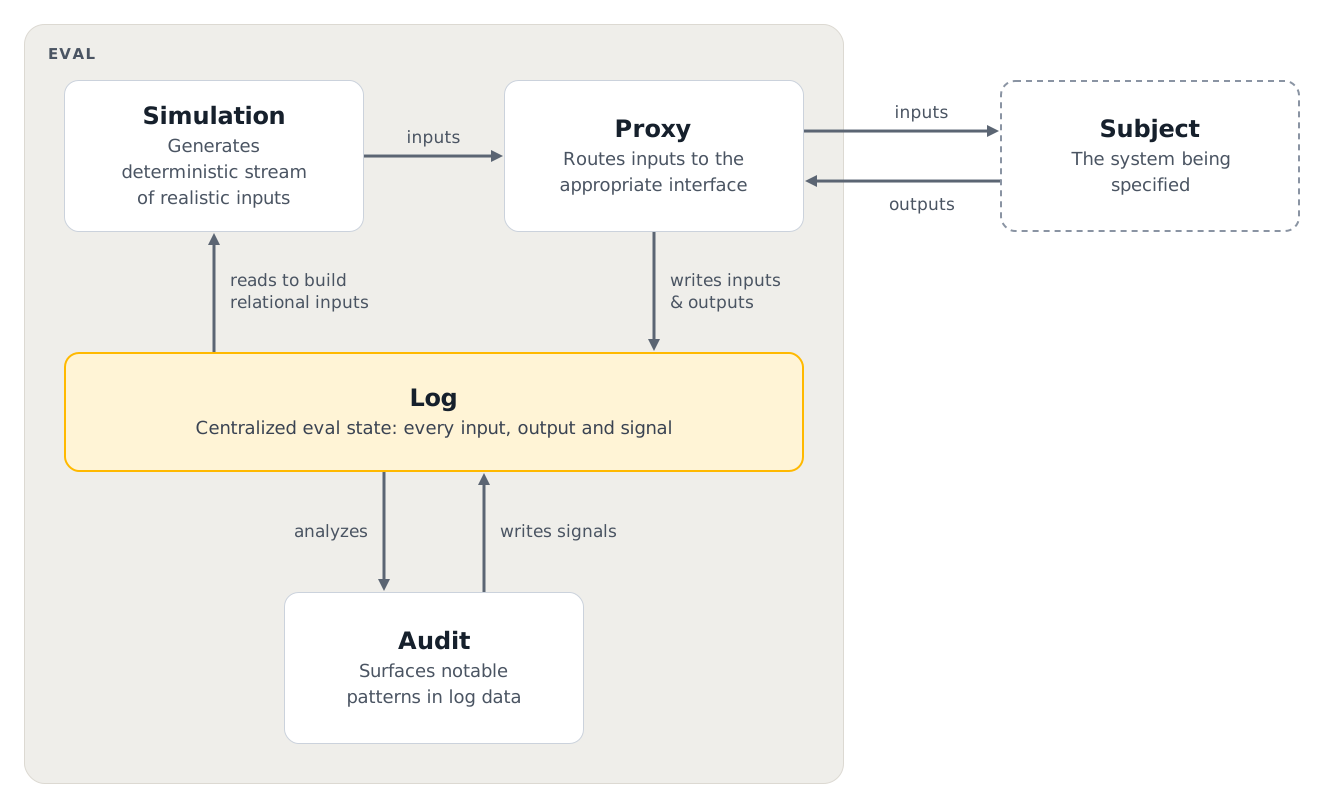
A spec describes the behavior of a system - its subject. It consists of a proxy, a simulation and an audit.
See the spec reference for more details.
Subject
The subject of a spec is the system it is describing. It could have arbitrary topology, from a stateless application to a service-oriented architecture.
Eval
An eval detetermines if a spec holds for a given deployment of its subject.
You can run an eval using the rngo eval CLI command.
Log
The log stores all inputs, outputs, signals and metadata during an eval.
It is the centralized states as the proxy, simualtion and audit may each write to and / or read from it.
See the log reference for more details.
Proxy
The proxy routes inputs to the appropriate channel, at the correct time. The channel is responsible for formatting the input, sending it to the appropriate interface in the subject, and returning any outputs.
The proxy writes both inputs and outputs to the log, along with any metadata (e.g. errors).
In the spec, the proxy is defined via the channels parameter.
Simulation
A simulation produces a deterministic stream of inputs, interleaved from a series of logical effects, that are sent to a proxy.
In the spec, the simulation is defined via the effects parameter.
Audit
An audit surfaces notables signals from the inputs, outputs and metadata of the log.
In the spec, the simulation is defined via the signals parameter.